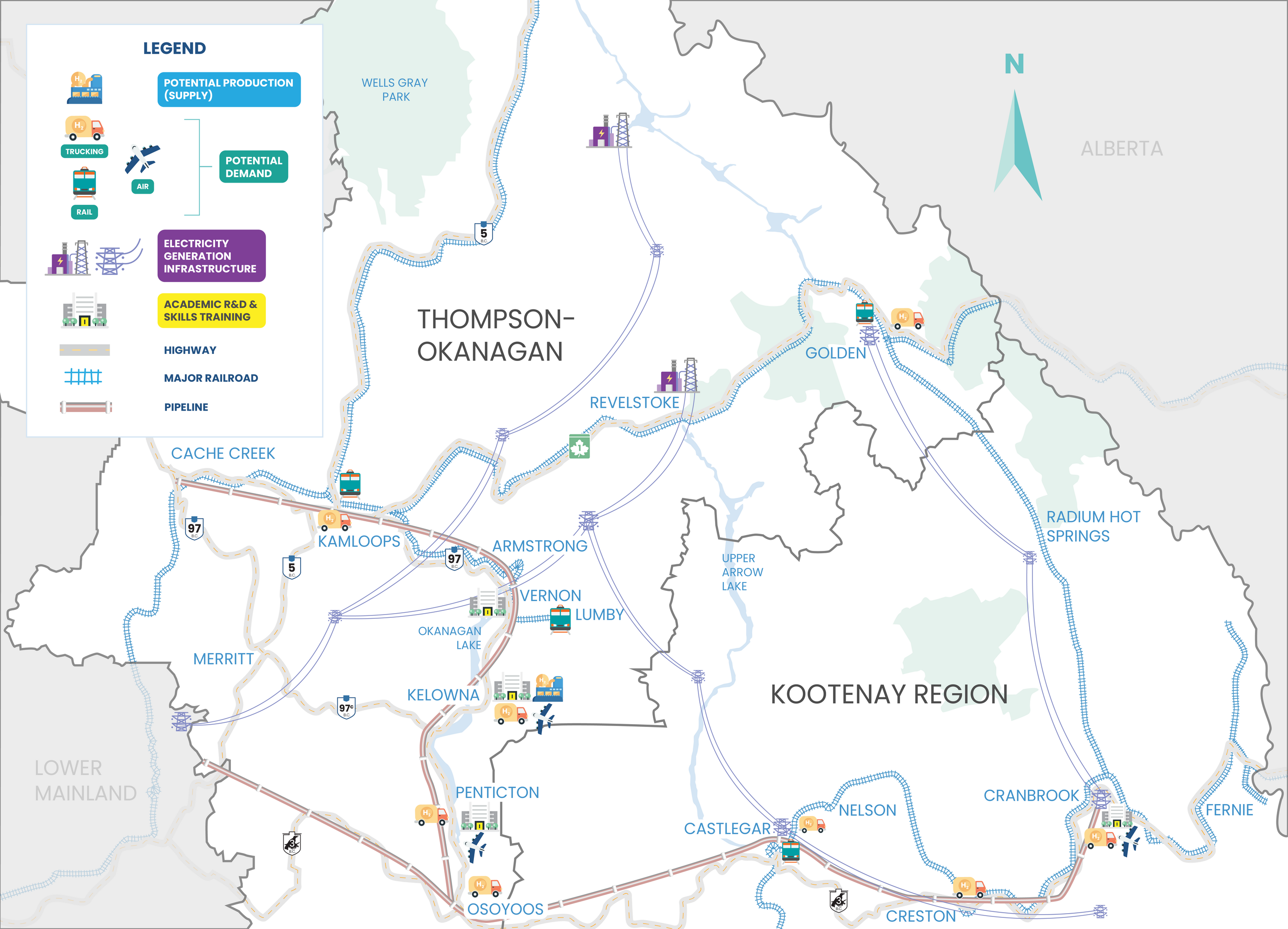
This opportunity assessment, commissioned by the British Columbia Ministry of Energy and Climate Solutions’ Clean Energy and Major Projects Office (CEMPO), includes a detailed report and ecosystem diagrams exploring future hydrogen hub development in BC's Southern Interior. Download the report and visual assets.
Executive Report Summary
To drive progress towards CleanBC goals and implement actions from the BC Hydrogen Strategy, CEMPO is working with Foresight to examine the potential for hydrogen hub development in the following regions where project development is underway and potential sources of demand exist: the Lower Mainland, Northeast BC, Interior BC (Kootenays and Okanagan), and Vancouver Island. By co-locating hydrogen production and end-use applications, hubs can ensure a balanced market while accelerating the growth of the local economy.
Foresight reviewed publicly available literature and consulted with regional experts to investigate the following three topics:
1
Supply
Potential sources of supply in the region, including feedstocks, production methods and locations, and transportation and storage.
2
Demand
Potential sources of hydrogen demand within the region, cost trends, and forecasts for demand growth.
3
Regional Considerations
Competitive advantages of the region and opportunities for collaboration with neighbouring jurisdictions, including workforce considerations.
It is now well-known that a variety of low-carbon energy sources, technologies, and innovations will be necessary to achieve regional emissions reduction goals, and hydrogen appears likely to fill a role in instances where direct electrification is neither technically feasible nor cost-effective. The Southern Interior appears well-placed to develop a hydrogen hub for several reasons:
- Existing Infrastructure: Regional gas infrastructure can be adapted for hydrogen production, storage, and distribution.
- Low Carbon Electricity: BC’s renewable hydroelectric power provides a low-carbon pathway for hydrogen production.
- End-Use Applications: There are potential demand-side applications for hydrogen use in the region, including trucking, rail, and industrial decarbonization.
- Proximity to Alberta: The Kootenays neighbour Alberta’s hydrogen development zones, which is beneficial for potential trade, shared technology development, and shared energy resources.
- Supportive Policy Environment: Local and provincial commitment to foster sectoral growth through the groundwork of the BC Hydrogen Strategy and complementary programs and policies.
Sources of Supply
Turquoise hydrogen and green hydrogen are likely to be the most suited to BC's Southern Interior.
Turquoise Hydrogen
Turquoise hydrogen is produced from natural gas using high temperatures to break methane into hydrogen and solid carbon.
Green Hydrogen
Produced by splitting purified water into hydrogen and oxygen, using electricity. Known as “green” hydrogen when renewable sources of electricity are used as the feedstock (e.g., wind, solar, or hydro).
As we look towards 2030-2035, cost and carbon intensity projections are critical variables. The BC Hydrogen Strategy estimated that a competitive production cost would need to be no higher than $3/kg by 2030. A literature review indicated that current projections for 2030 blue hydrogen production costs in BC fall between $2.14 and $2.71/kg. Furthermore, latest research from North X Climate Tech estimates the 2030 carbon intensity of blue hydrogen to be between 12.2-37.4 gCO2e/MJ. Most of the estimates fall below the low carbon threshold of 36.4 gCO2e/MJ adopted in the BC Hydrogen Strategy, which is meant to be a starting point to define low carbon production, and represents a 60 per cent reduction “below the intensity of hydrogen produced from natural gas.”
End-Uses
Demand is another matter and is subject to change as technologies evolve between now and 2050. However, the current evidence suggests that the hub’s primary hydrogen end use will be heavy transportation. Based on expert feedback and literature, we separate potential end uses based on whether they appear feasible and well-suited for the hub's needs by 2035.
Well Suited for the Region in 2035
- Heavy-Duty Vehicles: Fuel cells use hydrogen as a fuel to create electricity, water, and heat. Fuel Cell Electric Vehicles (FCEVs) are being explored as an internal combustion engine replacement for transportation applications that have limited cost-effective decarbonization options.
- Rail: Hydrogen-powered trains, which emit only water vapour, offer a sustainable alternative to diesel locomotives. Pilot projects are already underway in the region.
In Development/Further Evidence Needed
- Industrial Decarbonization (Hydrogen for Heat & Power Generation): Low-carbon hydrogen can substitute for fossil fuels used as energy sources and combusted to produce high-temperature heat in industrial processes. Off-road vehicles (e.g., tractors, mining trucks) could also be transitioned to FCEVs.
- Energy Storage: Hydrogen can be stored until needed and used as a source of power generation either through a fuel cell or combustion. However, this does not project to be a cost-competitive use beyond on-site power generation for industrial facilities.
Not Suitable for the Region in 2035
- Buildings (Blending Hydrogen for Heat): Utilities are exploring the use of hydrogen to reduce the carbon intensity of provincial natural gas by injecting it into the pipeline network. While there is value in blending hydrogen as a short-term anchor tenant in the region, the small amount of hydrogen expected to be produced in the region by 2035 would likely be more effectively utilized in other sectors, such as on-road and off-road transportation, given that past research suggests blending is unlikely to make a meaningful difference in BC’s emission reduction goals.
Regional Advantages and Challenges
Competitive Advantages of the Southern Interior
- Research & Development Leadership: UBCO, with support from FortisBC, launched the Hydrogen Research Lab (H2LAB) to support cutting-edge research such as: the impacts of blending hydrogen into BC’s gas supply, how hydrogen and hydrogen-enriched natural gas affect current infrastructure, what codes and standards are needed for safe and reliable delivery, and various demand-side applications of hydrogen in the region. The H2LAB will serve as a focal point for academia and industry to work together and advance a hydrogen hub in BC’s Southern Interior.
- Industrial Base: The presence of large, energy-intensive industries such as mining and forestry creates potential anchor demand. These industries often operate large vehicle fleets and require significant process heat, representing a substantial decarbonization opportunities where hydrogen could play a role.
Challenges to Overcome
- Transportation Infrastructure: While the region has extensive natural gas infrastructure, adapting it for hydrogen production and distribution poses significant challenges.
- Regulatory Hurdles: Governments and regulators must work with industry to streamline regulatory processes and reduce delays and uncertainty.
- Jurisdictional Alignment: Standardized safety protocols, environmental regulations and infrastructure are needed between states and provinces.
- Power Availability: Monitoring resource constraints, particularly water and electricity, will be essential. The region will need to balance its power needs with other industrial and residential demands, potentially requiring large investments in new power generation and transmission infrastructure.
- Market Development and Demand: Fostering local demand for hydrogen in the region could be challenging due to its relatively small population and industrial base compared to more densely populated areas of the province. It will be critical to work together to jointly stimulate demand and incent technology adoption.
Mapping the Ecosystem
Building on our first series of provincial ecosystem vision maps, we mapped infrastructure in the region to envision what a future hydrogen ecosystem could look like in 2035. Click to download.
Recommendations for Hub Partners
Based on the findings of this opportunity assessment, Foresight developed recommendations for hub partners to advance the Southern Interior hydrogen hub within the decade. We encourage readers to review the full report for further information on each recommendation and their varying timelines.
1
Supply
- Provide further public clarity on electricity infrastructure adaptation and growth
Recommendation Lead: Province, Utilities - Continue support for market-based policies that increase competition between hydrogen and carbon-intensive fuels
Recommendation Lead: Province - Map industrial sites in high-opportunity zones to support project proponents and investors
Recommendation Lead: Local Governments - Incorporate hydrogen development zones in land-use planning
Recommendation Lead: Local Governments
2
Demand
- Focus the Southern Interior hub’s development around heavy transportation
Recommendation Lead: All Partners - Limit consideration of blended hydrogen for heat as a pathway to reduce emissions
Recommendation Lead: Province, Utilities - Continue government funding for demonstration projects and communicate outcomes
Recommendation Lead: Province
3
Regional Considerations
- Explore new ways to enhance knowledge transfer within the Southern Interior
Recommendation Lead: All Partners - Explore the creation of a regulatory task force
Recommendation Lead: Province, Utilities, BCER - Develop a hydrogen workforce development strategy
Recommendation Lead: Province, Industry, Post-Secondary Institutions - Continue support for public education and awareness activities
Recommendation Lead: Province, Industry - Incorporate hydrogen development into Official Community Plans (OCPs)
Recommendation Lead: Local Governments
This opportunity assessment serves as a midpoint marker, acknowledging the progress to date and setting expectations for the coming decade. The path forward involves a combination of strategic planning, collaborative engagement, and targeted investments. By working together to address identified challenges, public and private sector partners can realize the full potential of a hydrogen hub in the Southern Interior region.
Building a Clean Hydrogen Economy Starts Here
Discover key insights, market opportunities, and the latest advancements in hydrogen innovation.


