Industrial energy use is a major emissions driver—Calgary-based SolarSteam is working to change that with their innovative thermal technology.
Industrial heat powers much of the modern world, from the clothes we wear to the food we eat to the materials that build our cities. But this critical energy source comes with a heavy carbon cost. Globally, industry accounted for 37% of total energy use in 2022 (up from 34% in 2002), with a substantial portion devoted to generating high-temperature heat for production processes.
In Canada, Industrial Energy Systems—including combustion, process heating, motors, and compressed air—consume approximately 80% of all energy used by the sector. Despite this massive demand, 30% to 40% of that energy is typically lost. With heating responsible for roughly 10% of the country’s total greenhouse gas (GHG) emissions in 2023, finding cleaner, more efficient ways to deliver industrial heat is both an environmental and economic priority.
High temperature heat is essential for producing everything from chemicals and plastics to food and metals—but delivering it efficiently and sustainably remains one of the industrial sector’s biggest decarbonization challenges. That’s where Calgary-based cleantech venture SolarSteam comes in.
Foresight’s Stacey Armstrong recently spoke with SolarSteam CEO Apostol Radev to learn how the company is advancing solar thermal technology to decarbonize industrial heat—and how collaboration is helping bring their first commercial-scale project to life.
How SolarSteam Delivers Industrial-Scale Clean Heat
Q: What does SolarSteam do, and how is your approach to solar thermal technology uniquely positioned for industry?
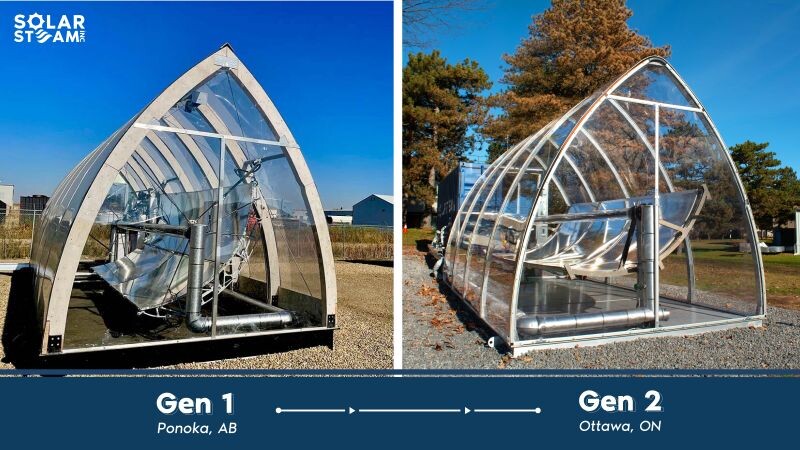
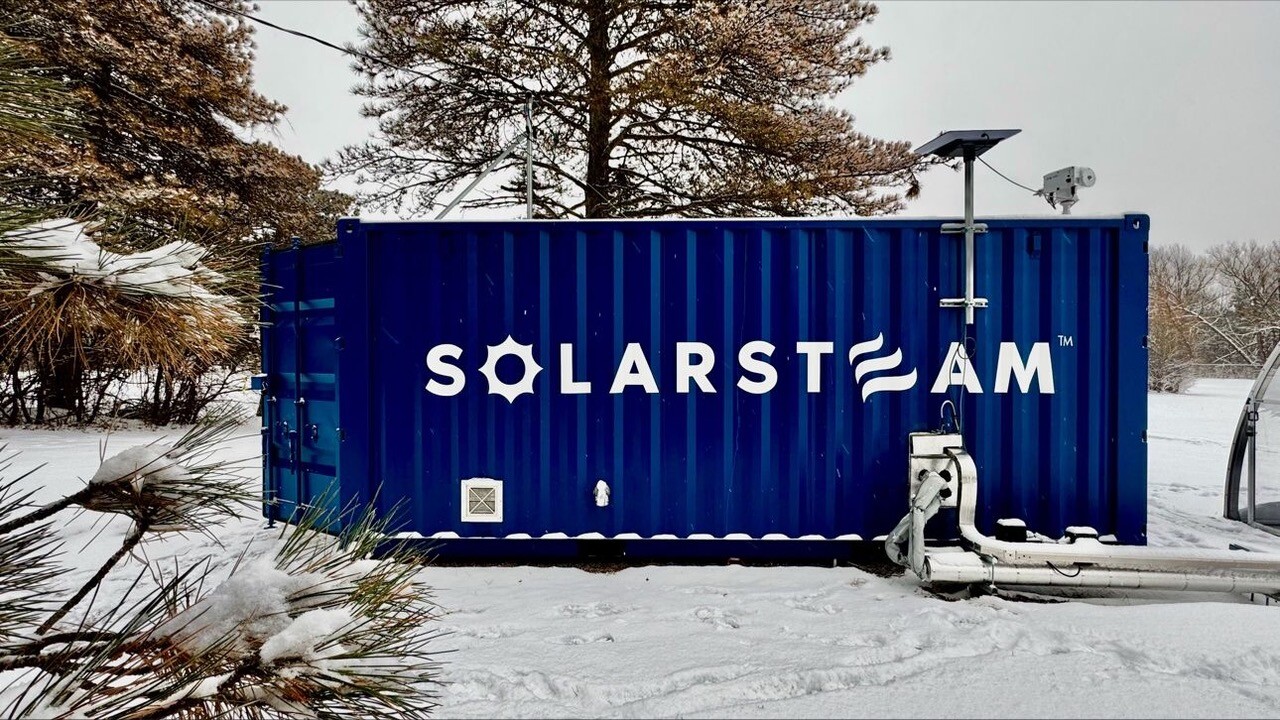
A: SolarSteam delivers high-temperature industrial heat—up to ~320°C—using lightweight, enclosed parabolic-trough collectors. By sealing the mirrors inside a transparent enclosure, we eliminate wind loading, hail damage, and soiling. We’ve also optimized the receiver, tracking, and control system for cold-climate reliability. Our DfMSA™ (Design for Manufacturing, Shipping & Assembly) strategy allows each 50kWt “Obelix™” module to be pre-assembled into standard shipping containers for fast, on-site installation. This reduces capital costs and deployment timelines—making SolarSteam’s solar thermal systems among the most cost-effective and scalable clean heat solutions on the market.
Q: Tell us about your first-of-a-kind (FOAK) commercial project in Alberta. What makes it a milestone for both SolarSteam and the cleantech sector in Canada?
A: Our FOAK commercial project, supported by $2.8M from Emissions Reduction Alberta (ERA), is deploying the SolarSteam system at Base Element Energy’s site in Cynthia, Alberta. It integrates our collectors with Sunamp’s phase-change material storage, delivering process heat through a heat-as-a-service model. With 30 Obelix™ modules in the field, we’re demonstrating TRL 9 and establishing a manufacturing playbook for future scale-up. Scovan is leading Engineering, Procurement, and Construction (EPC), as well as integration, while BSB Manufacturing handles precision fabrication—showcasing how interprovincial collaboration can fast-track climate tech commercialization in Canada.
Why Alberta’s Cleantech Ecosystem Fuels SolarSteam’s Growth
Q: Alberta has played a key role in your growth. What makes the province such a strong environment for cleantech partnerships?
A: Alberta offers the perfect mix: world-class solar resources, deep energy engineering expertise, and pragmatic regulators who understand large-scale infrastructure. Organizations like ERA, Alberta Innovates, and Foresight Canada create non-dilutive capital and matchmaking platforms, while local partners like Scovan bring rapid prototyping and supply chain depth. That combination of talent, funding, ecosystem support, and industrial partnerships makes collaboration here not just possible—but inevitable.
Q: You’ve been part of multiple Foresight programs—Foresight 50, Launch, Deliver, and Earth Tech. How has that ecosystem support helped SolarSteam scale or refine its approach?
A: Foresight’s programs have played a key role in shaping both our technology and commercialization strategies. We were part of the inaugural in-person Launch and Deliver cohort in Calgary back in 2020, and we’ve grown significantly since then. Special thanks to our original Executives-in-Residence (EiRs) Heather Herring and Jeff Reading—their guidance was instrumental in my development as a CEO and in SolarSteam’s success. Foresight also helped us build meaningful connections, access funding, and hone our product-market fit.
Tackling Challenges and Supply Chain Disruptions
Q: What were some key lessons from building and testing your early pilots?
A: When we deployed our TRL 7 pilot in the field, it became clear that labour—not materials like steel or mirrors—was the biggest cost driver. That realization led us to completely rethink our approach using DfMSA™ (Design for Manufacturing, Shipping & Assembly). Building on the traditional “Design for Manufacture and Assembly” model, we retained the core goal—make every part simple, cost-effective, and repeatable to produce—but added two key constraints: components must ship efficiently and assemble quickly on-site with minimal labour. In short, every element of the system—from the collector to the control system and enclosure—is now optimized not just for the factory floor, but for the shipping container and the final wrench turn in the field.
COVID-era supply chain delays reinforced this insight. We redesigned all critical parts for local, Canadian manufacturing—cutting risk and aligning with our modular, DfMSA™ model.
The human takeaway is simple—every “oh-no” moment becomes a new engineering specification, control algorithm, or supplier partnership and new intellectual property (IP). By treating surprises as hidden product requirements, we built the resilience needed to move from our first Alberta pilot to securing a contract for a 1.5 MWt FOAK system and laying the foundation for full-scale commercialization.
Q: What adoption barriers have you faced—and how are you addressing them across different industries?
A: The first barrier is integration, and usually comes from plant managers asking, “Will this slot into my process without a shutdown?” Our answer is yes—and we prove it with modularity. Our Lego-style approach allows clients to start with a small demo alongside existing systems, then expand after witnessing real-time performance, without disruptive retrofits.
Reliability is next. In sectors like water treatment, data centres, chemicals, and heavy oil, even a single hour without energy can cost millions. That’s why we designed our system to match the reliability of a gas boiler, delivering consistent 24/7 performance. It features automated controls, minimal maintenance, and an integrated thermal energy storage (TES) to bridge cloudy periods, overnight production, and enable rapid start-ups at sunrise. By demonstrating this level of reliability in Alberta’s harshest weather, we’re eliminating the operational concerns that often slow down hardware adoption.
Finally, the economics must work. Our heat-as-a-service model eliminates upfront client CapEx, while performance dashboards provide transparency on energy delivered pricing and reduce risk. We finance projects through Special Purpose Vehicles (SPVs), and our FOAK system will demonstrate full TRL 9 without requiring another $20M in funding. We’ve combined seamless integration, proven reliability, venture scalable economics, and de-risked technology into a solution that converts early traction into signed, bankable commercial project.
What’s Next: Scaling Clean Heat and Entering New Markets
Q: What’s next for SolarSteam as you build on your FOAK momentum? Any upcoming projects or goals you’re especially excited about?
A: We’re focused on scaling up production with our partner BSB Manufacturing, and expanding into new markets and regions. Upcoming projects include larger-scale deployments in green fuels and cooling for data centres. We’re also focused on ongoing product optimization using advanced manufacturing to further enhance the efficiency and scalability of our solutions. We’re seeing strong interest from industrial partners, and exciting deployments are ahead—we’re just getting started!
Q: What advice would you share with other cleantech startups trying to move from pilot to commercialization?
A: Build a pilot as early as possible and simulate the behaviour of the client rather than looking for the perfect client to demonstrate with. Check your ego at the door, ask everyone you know for help, and don’t underestimate the value of local partners. Sometimes, the welder down the street is the reason you hit your go-live date instead of facing a six-month delay.
Foresight is driving the clean energy transition through strategic support and industry connections for cleantech ventures.
Learn more about how Foresight is helping Canada reach a 100% net zero electricity system by 2035.