What Is Carbon Management—and Why Is It Critical to Net Zero?
As cleantech advances across sectors, it's worth going back to basics to understand the core innovations driving climate action. Carbon Management—through technologies like Carbon Capture, Utilization, and Storage (CCUS) and Carbon Dioxide Removal (CDR)—is key to reducing emissions, supporting natural systems, and creating new economic value on the path to net zero.
Carbon Management refers to a suite of technologies and approaches designed to reduce or remove current and legacy CO₂ emissions. This includes both CCUS and CDR technologies.
Carbon Capture, Utilization, and Storage (CCUS)
These technologies are designed to capture and store carbon dioxide before it reaches the atmosphere. This technology is applicable to hard-to-abate and heavy emitting industries such as commodity and materials production, oil and gas, non-renewable power generation, among others.
- Capture: Technologies that capture CO₂ from a point source emission (e.g., smokestacks)
- Utilization: Technologies that typically use electrochemical processes to convert captured carbon dioxide into useful chemicals and materials such as syngas, ethylene, and silicate.
- Storage: Pumping CO₂ into permanent geologic sequestration zones.
- Measurement, Monitoring and Verification (MMV): Technologies and plans that verify the CO₂ remains securely stored—critical for accessing climate finance and demonstrating impact. This is also known as Measurement, Reporting, and Verification (MRV).
Carbon Dioxide Removal (CDR)
These technologies remove CO₂—also known as legacy emissions—from the atmosphere. These solutions are categorized into two areas:
- Nature-based Solutions (NbS): Projects or processes to restore existing natural processes that support carbon uptake, biodiversity, and reverse environmental damage. NbS solutions can include:
- Restoring and protecting forests and wetlands
- Coastal habitat restoration (coral reefs, mangroves, salt marshes, etc.)
- Sustainable farming
- Building greener cities (green roof, rainwater harvesting, etc.)
- Engineered Solutions: Technologies that can be deployed to remove carbon from the atmosphere. Engineered solutions can include:
- Direct Air Capture (DAC)
- Direct Ocean Capture (DOC)
- Enhanced Rock Weathering
- Biochar, Biocarbon, Biocoal
- Bioenergy with Carbon Capture (BECCS)
- River Restoration
- Ocean Alkalinity Enhancement (OAE)
Why CCUS and CDR Are Both Essential for Climate Action
The Earth has an annual carbon budget that our natural systems can absorb. Since the industrial revolution, we have consistently surpassed this budget and emitted enormous quantities of CO₂ into the atmosphere. Picture this: Our carbon budget is an overflowing bathtub where the tap is our current emissions and the drain is nature’s ability to remove the carbon dioxide.
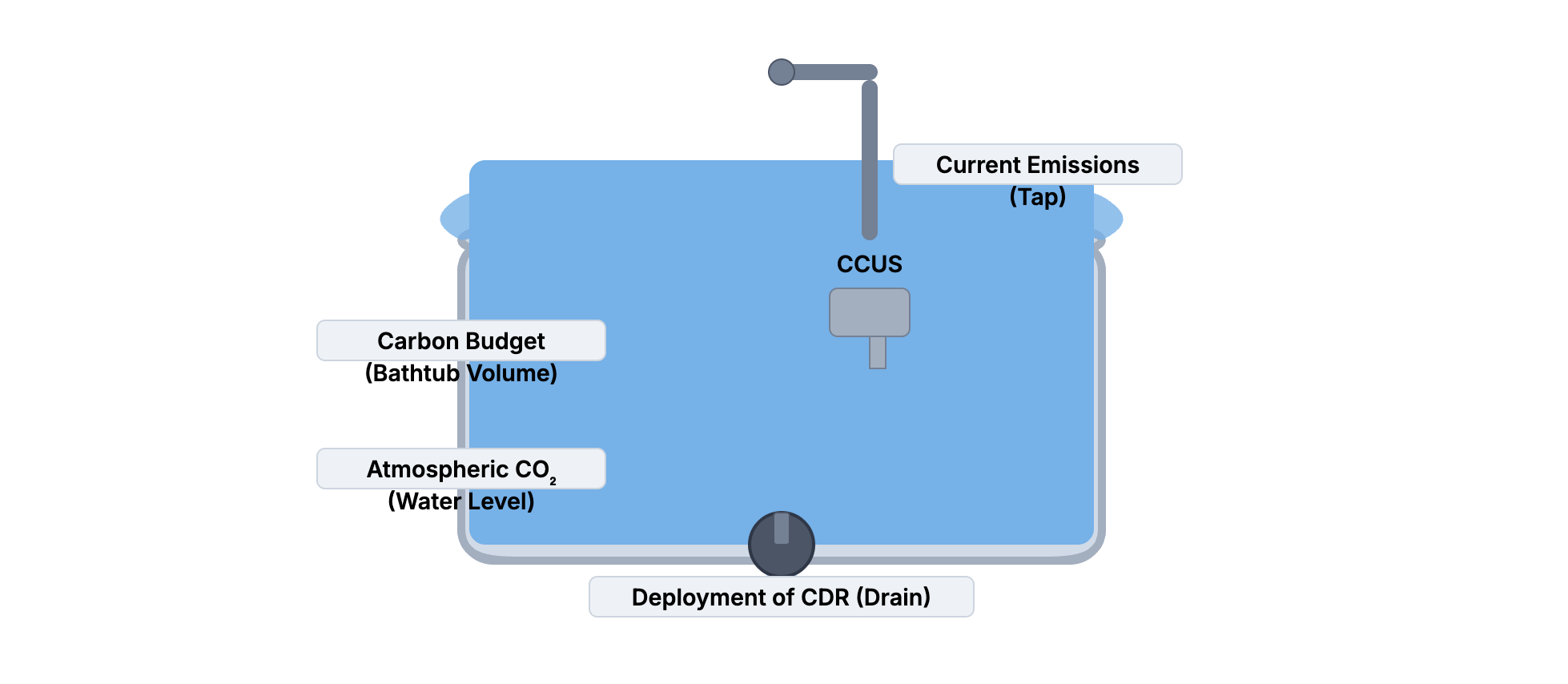
In this example, the easiest way to stop the overflow is to turn off the tap (our current emissions)—but this is a long process, and in some industries it's impossible. This is where CCUS plays an important role. We can’t shut off the main tap, but we can significantly reduce its flow with the deployment of CCUS technologies. The other key aspect of this example is the drain—opening up the drain will allow more carbon to be removed from the atmosphere. We can accomplish this by deploying CDR technologies to remove legacy emissions. Using both approaches is essential to meet international climate goals and avoid the worst impacts of climate change.
Common CCUS Misconceptions
- It’s an unproven technology: CCUS was first commercially deployed in Norway in 1996. The project has now stored more than 20 MtCO₂ in a deep saline formation located around 1 km under the North Sea. There are now global facilities deployed that capture over 40MtCO₂ per year, and this number continues to grow each year.
- It’s too expensive: While deploying any new technology is costly, technology advancements continue to reduce the cost of CCUS. Inaction on climate change is proven to be more costly long-term than immediate action, with utilization efforts also creating new revenue streams through feedstock chemicals and products.
- It delays climate action: While fossil fuel industries are likely to be the first adopters of this type of technology, there are a number of critical, hard-to-abate industries that will rely on CCUS technologies to reach net zero emissions. For example, in the cement industry, traditional production emits approximately one tonne of CO₂ per one tonne of cement produced. Heidelberg materials in Edmonton is racing to become the world’s first net zero cement producer.
Common CDR Misconceptions
- We don’t need it—emission reductions will be sufficient: It is critical we mitigate CO₂ legacy emissions to reach our net zero goals. By not managing our emissions, we won’t be able to reach a regenerative state and reverse the significant impacts of climate change.
- It’s too expensive: CDR technologies offer a huge economic opportunity to be deployed here in Canada. As the carbon credit market continues to scale and new technologies are deployed, Canada’s natural resources offer a huge opportunity to lead in the CDR field and add highly skilled jobs and increase our GDP annually.
- Nature is enough: Our planet's natural processes can't keep pace with current CO₂ emissions, leading to the climate crisis. Carbon Dioxide Removal (CDR) technologies enhance natural removal, accelerating processes that typically occur over geologic timescales to meet urgent human timescales.
Opportunities for Canada
Canada is rapidly emerging as a global leader in Carbon Management, an industry with significant economic opportunity. Leveraging its globally recognized expertise, top-tier research and testing facilities, and favourable geology for CO₂ storage, Canada is critical in the fight against climate change.
Canada is also home to numerous cleantech ventures deploying groundbreaking CCUS and CDR technology, including:
For more on Canada's Carbon Management strategy, visit the Government of Canada website.
Learn more about how Foresight is championing Carbon Management technologies through strategic mentorship, industry connections, and expert support.
Looking to deploy CCUS or CDR technologies? We can help. Apply for our cleantech adoption program.


